Use negative reviews on G2 and other software review sites to find where competing tools fall short, prove where yours is a better fit, and reach out with a useful answer, and build a campaign around a real reason to switch.
Imagine you market a CI tool. You could publish another comparison page that says you’re faster and cheaper. But what if the buyer’s actual problem is that they can’t forecast the cost of rerunning builds across 60 repositories? A generic speed claim leaves that person with all the work. A cost-per-successful-build worksheet gives them something they can take to their platform lead.
That’s the opportunity in competitor reviews. A customer can recommend a tool and still describe the exact workflow they’d consider moving. Their complaint can tell you what they were trying to do, what got in the way, and which trade-offs they already accept. That can give you a reason to start a conversation with the person who named the gap, where contact is permitted. It can also tell you what to offer other buyers with the same problem.
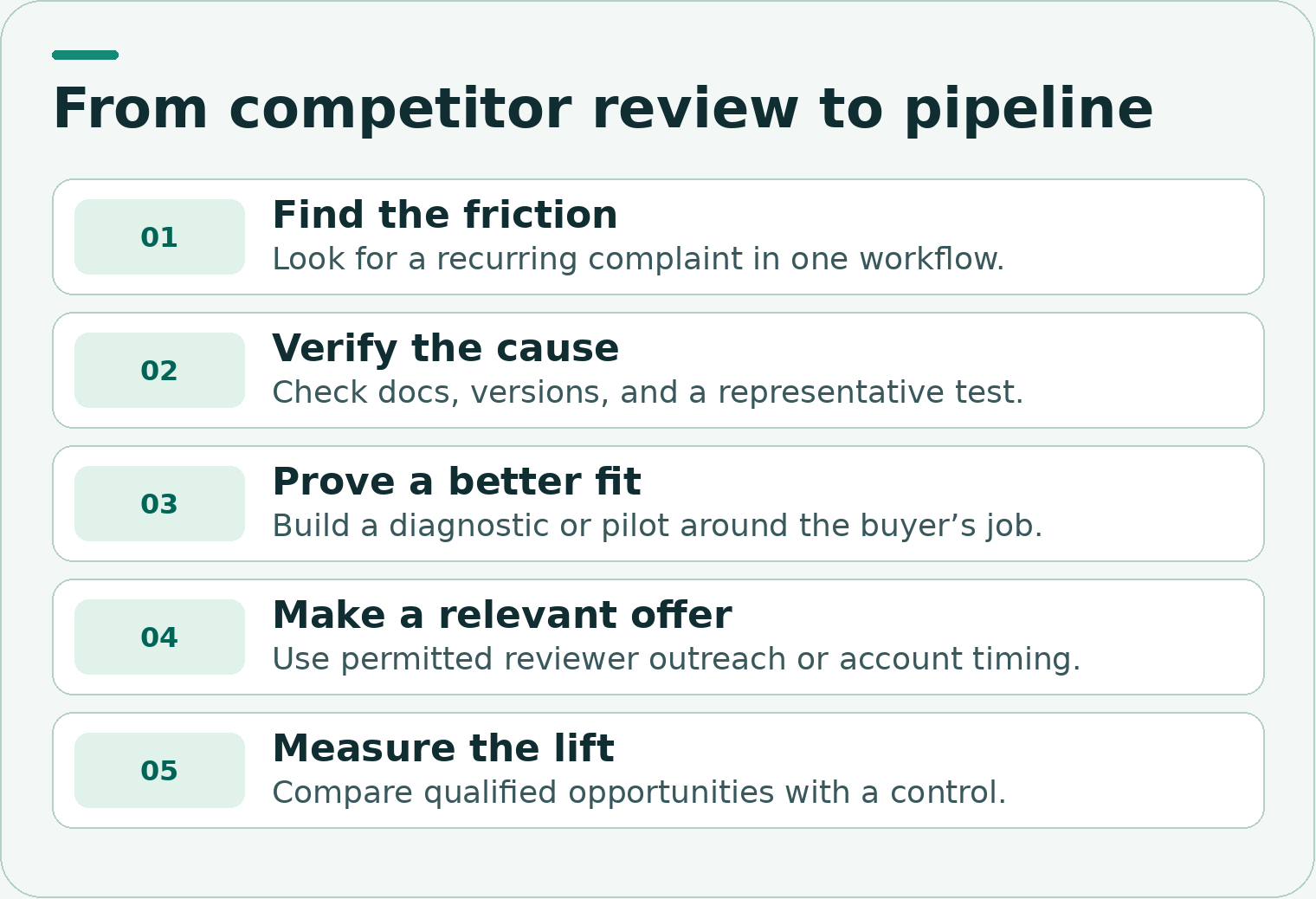
A review-led GTM motion uses recurring complaints to find where your devtool can win. Verify the problem, prove a better outcome on a representative workload, and package the proof as a diagnostic, comparison, or pilot. Where contact is permitted, reach out to a reviewer with a useful answer to their specific problem. Use account-level signals to time outreach to other buyers. Measure whether the motion adds qualified opportunities.
Why run a campaign around a competitor’s weakest workflow?
The incumbent already has advantages you have to account for. Its users know how to operate it. It may be bundled into a broader contract. The platform team may own years of dashboards, integrations, and runbooks. “We have better features” gives those teams little help deciding which part of that investment is worth changing.
Start with a sharper question: Which team, under which conditions, would go through the work of switching? Competitor reviews can surface the conditions. A request spiking cost, a permissions model that blocks delegation, or a migration that forces downtime can each point to a distinct segment and campaign. A repeatable motion starts when you can show an improvement that survives a real evaluation.
The buying research supports publishing that evidence early:
| Finding | What to do with it |
|---|---|
| In G2’s 2026 survey of more than 1,000 software buyers and decision-makers, review sites (38%) and AI chatbots (37%) were the top reported sources shaping which vendors made the shortlist. | Give buyers a specific reason to include you before a sales conversation. G2 2026 Buyer Behavior Report · G2 findings |
| In TrustRadius’s survey of 1,862 technology buyers from its network, 74% said reviews inform their purchase decisions. Among buyers who used AI, 94% fact-checked its output at least some of the time. | Put reproducible evidence, assumptions, and links where a buyer can inspect them. TrustRadius 2026 B2B Buying Disconnect |
| In 6sense’s 2026 research, 92% of eventual winners were on the initial shortlist. Dissatisfaction with the current solution was cited in 11% of evaluations that ended in purchase and 22% of those that stalled or were abandoned. | Earn a place on the shortlist and look for a reason the buyer can act now, such as a funded rollout or budget review. 6sense 2026 Global B2B Buyer Experience findings |
| In a Gartner survey of 646 B2B buyers, 67% preferred a rep-free buying experience and 45% reported using AI during a recent purchase. | Make the first assessment self-serve and make technical help easy to request. Gartner buyer survey |
These studies span different populations and questions. They describe buying behavior. Estimate the conversion rate of this campaign from your own pilot.
Should a founder spend a week on this?
Start here if the same alternative keeps coming up in sales calls, the buyer can isolate a workload, and your team can show a meaningful result without building a new feature. For a bootstrapped CI company, that could mean one jobs-heavy repository that the buyer can move without touching the rest of their CI estate.
Look for two costs before spending on a campaign. First, estimate what the buyer saves in money, engineering time, or risk. Then estimate what they have to spend to switch, including time to get approval, move a workload, and run both systems. The proposed pilot should answer whichever part of that calculation is most uncertain.
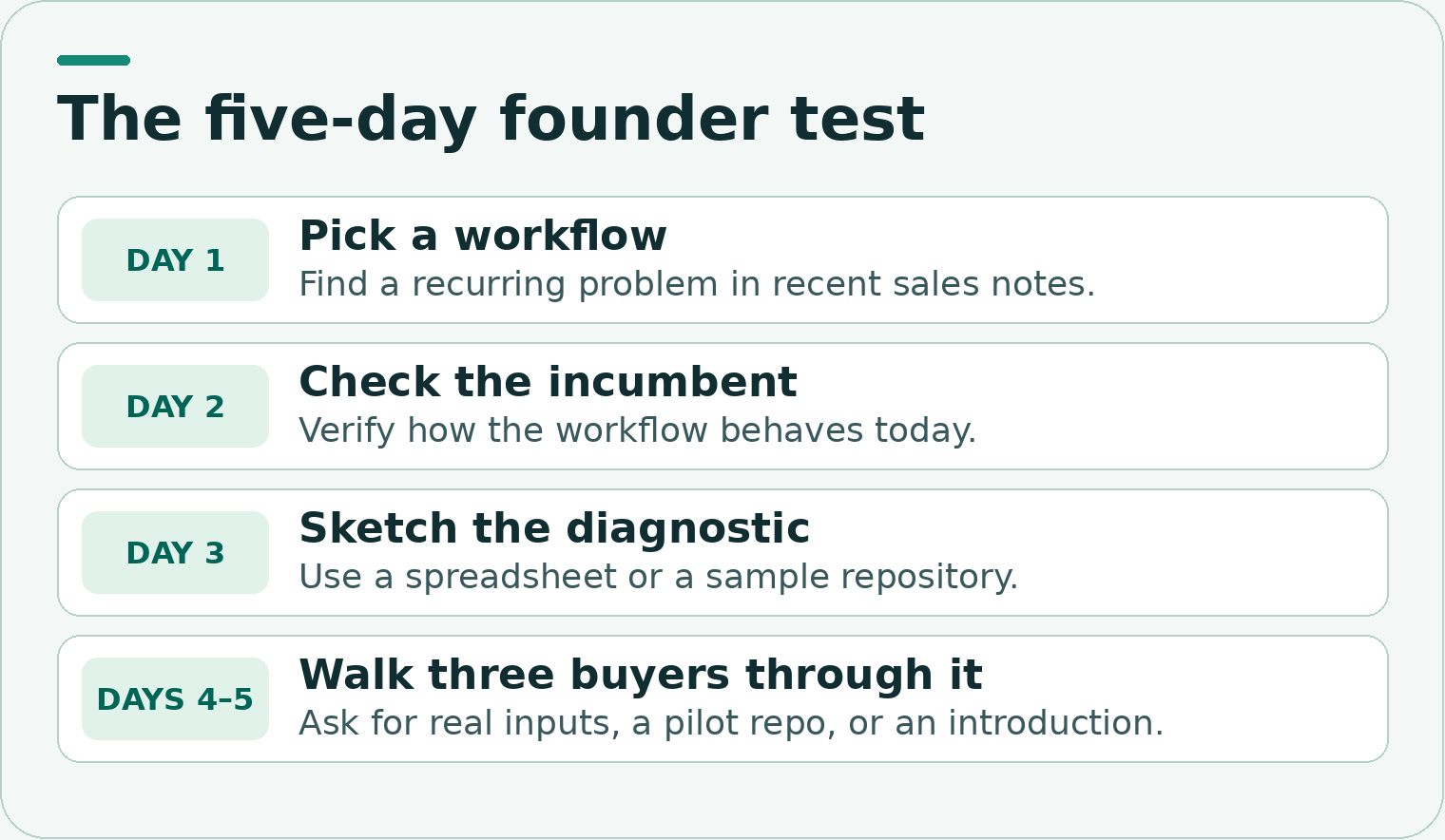
Use your CRM, a spreadsheet or sample repo, and one engineer who can verify the claim.
A buyer who shares representative inputs or brings in the workflow owner gives you more evidence than one who says the idea sounds interesting. If nobody can name a workload they’d move, find out why before buying an intent feed or building a calculator. The problem might be real but too cheap to fix in place, too risky to move, or owned by a team you can’t reach.
1. Look for problems important enough to change tools
Choose one segment and two or three alternatives that actually show up in your deals. For an observability startup, “platform teams at Kubernetes-heavy SaaS companies that own their telemetry budget” is specific enough. Their alternatives might include an incumbent suite, an open-source stack, and a decision to keep tuning what’s already installed.
On G2 or another marketplace, start with the product listing. Where available, filter by company size and role, then look at recent reviews and the dislikes in mixed or favorable reviews. Read for the workflow, the consequence, and the workaround. A four-star review that describes a monthly billing issue can give you a better lead than a one-star review about an isolated support incident. Read positive reviews for the same workflow to learn why teams stay.
Set a manageable research target. For a first pass, try 40–60 eligible observations across two or three alternatives, including first-party notes if access to marketplace material is limited. Record your selection rules and keep separate counts for each source. Reviews are self-selected, and a sample chosen partly for complaints describes what you reviewed. Estimating how common the problem is across the customer base would require a representative sample.
| Where to look | What it can tell you |
|---|---|
| G2, Capterra, Software Advice, GetApp, and TrustRadius | How users describe friction and which workflows they value. Deduplicate syndicated posts before counting independent reports. G2 unified its vendor platform with Capterra, Software Advice, and GetApp in November 2026. G2 unified platform announcement |
| GitHub issues and technical forums | Which versions and configurations produce an issue, and what users did about it. Check whether the issue has since been resolved and use material within the source’s permitted scope. GitHub Acceptable Use Policies |
| Win/loss interviews, sales calls, and support notes | Who owns the problem, what the workaround costs, and what has to happen before the buyer can change tools. |
| Official documentation, pricing, and release notes | Whether the complained-about behavior still exists and under which plans, versions, or configurations. |
Confirm permitted use before collecting data. G2’s terms require prior written consent for covered automated extraction and commercial exploitation, and restrict specified uses of site content with AI systems and datasets. G2’s Community Guidelines prohibit republication of another vendor’s reviews or aggregate rating. Confirm that your agreement covers the access, retention, AI processing, and reuse you need. First-party interviews, internal notes, and independent product testing can provide the working dataset when marketplace permissions are limited. G2 Terms of Use, §§8–9 · G2 Community Guidelines
2. Turn a complaint into a campaign hypothesis
“Too expensive” could mean unpredictable usage, duplicate ingestion across environments, or a minimum contract that makes expansion hard. Each points to a different buyer and a different test. Capture enough context to tell them apart.
For each eligible observation, record a source reference, date, product, plan or version if known, role, workflow, friction, consequence, workaround, and a question that would verify the claim. Keep reviewer identities out of the campaign dataset. Count independent reports within each theme and retain examples that challenge your interpretation.
Use this brief to decide what happens next:
| Question | Example for a telemetry cost campaign |
|---|---|
| Who feels the pain? | Platform teams expanding Kubernetes telemetry across multiple services. |
| What breaks in the workflow? | The owner struggles to forecast how growing tag dimensions will affect usage while keeping the incident queries teams rely on. |
| Why might they act now? | They’re standardizing telemetry or setting the budget for an upcoming rollout. |
| What would prove a better fit? | A one-service test preserves the required queries and alerts, with a usage forecast the owner can reconcile. |
| What could kill the switch? | Alert parity, migration effort, contract timing, or dependencies on the incumbent suite. |
Before investing in a theme, talk to three people who match the target segment. Ask about the last time they hit the issue, how they worked around it, who paid in time or budget, and what would have to happen to revisit their current setup. Use customer research or opted-in panels to recruit. If every interviewee can solve the problem with a simple configuration change, you may have a useful educational page and a weak switching campaign.
Score each theme from 0 to 2 on independent corroboration, segment fit, business impact, strength of your technical proof, and switching feasibility. A practical starting rule is 8/10, with a mandatory check that you can demonstrate the outcome and offer a feasible first step. Calibrate the threshold once you know which themes deliver qualified evaluations.
Use AI to classify approved research
With permitted, de-identified inputs, AI can extract themes and group observations by mechanism. Hand-code the first ten records and compare the model’s output to catch broad categories that hide important differences.
Use only the approved records supplied. For each record, return its ID,
workflow, reported friction, consequence, workaround, and plan or version
if known. Keep unknown fields explicit.

Group observations by the mechanism that caused the friction. For each
theme, provide supporting IDs, contradictory IDs, possible duplicates,
and a test that would verify whether the problem still exists. Distinguish
observations from hypotheses. If you report a count, give its denominator.
Have someone who knows the product review every theme that makes it into a campaign. Changelogs, plan differences, and alternative configurations can change the interpretation. Keep the evidence trail so any claim can be rechecked later.
3. Build proof a buyer can use
Observability: give platform teams a way to forecast custom metrics costs
Datadog’s cardinality-based billing docs explain how unique combinations of metric names and tag values factor into custom metrics usage. Metrics without Limits can separate ingestion and indexing. This gives an observability marketer a concrete evaluation question: How do we keep the tag dimensions we need for incidents and forecast what they’ll cost as our services grow? Account for the buyer’s billing model, configuration, and contract. Datadog custom metrics billing · Metrics without Limits
- Build the diagnostic. Use sanitized hourly metric and tag counts. Model several configurations, including tuning the incumbent. In a synthetic example, 5 environments × 20 regions yields 100 combinations if every pair occurs. Adding 10 services per pair yields 1,000 combinations with all other dimensions held constant. A bill estimate still needs actual observed usage, metric type, included allowances, and rates.
- Offer a one-service pilot. Dual-write metrics for a week. Compare query coverage, alerts, estimated cost, and operator effort. Decide up front which queries and alerts are required for the pilot to pass.
- Package the result for the buyer. Give the platform lead a short summary for FinOps with costs by configuration, which incident queries remain available, and what migration work is left.
CI/CD: show what a successful build actually costs
CircleCI documents how compute uses credits and how resources such as storage and network usage can contribute under applicable plans. A CI buyer can use that information to ask a sharper question: What do we spend per successful build at the turnaround time our team needs? CircleCI credit usage · CircleCI FAQ
- Build the diagnostic. Divide attributable spend for a defined batch by the number of successful builds. Include failed attempts and retries in spend. Record queue time, cache hit rate, runner class, and storage or network costs where applicable.
- Run a fair comparison. Replay comparable jobs from the same commit. Document runner differences, warm and cold caches, run counts, median and tail turnaround, and any unmatched conditions. Give each product a reasonable configuration.
- Make switching manageable. Pick one repository. Map secrets, artifacts, branch protections, platform-specific runners, and rollback. Offer a pilot with an agreed cost and turnaround target.
The product mechanics in these examples come from vendor documentation. The diagnostics and pilots are campaign designs that a marketer could build and test.
Worked example: from a CI complaint to a founder-led offer
Suppose your research surfaces a pattern among platform teams: retries and cache misses make CI spend hard to explain. This is a hypothetical example. You confirm in interviews that the platform owner has to justify next quarter’s spend, can export job usage, and can test one repository. You now have a buyer, a deadline, and a feasible scope.
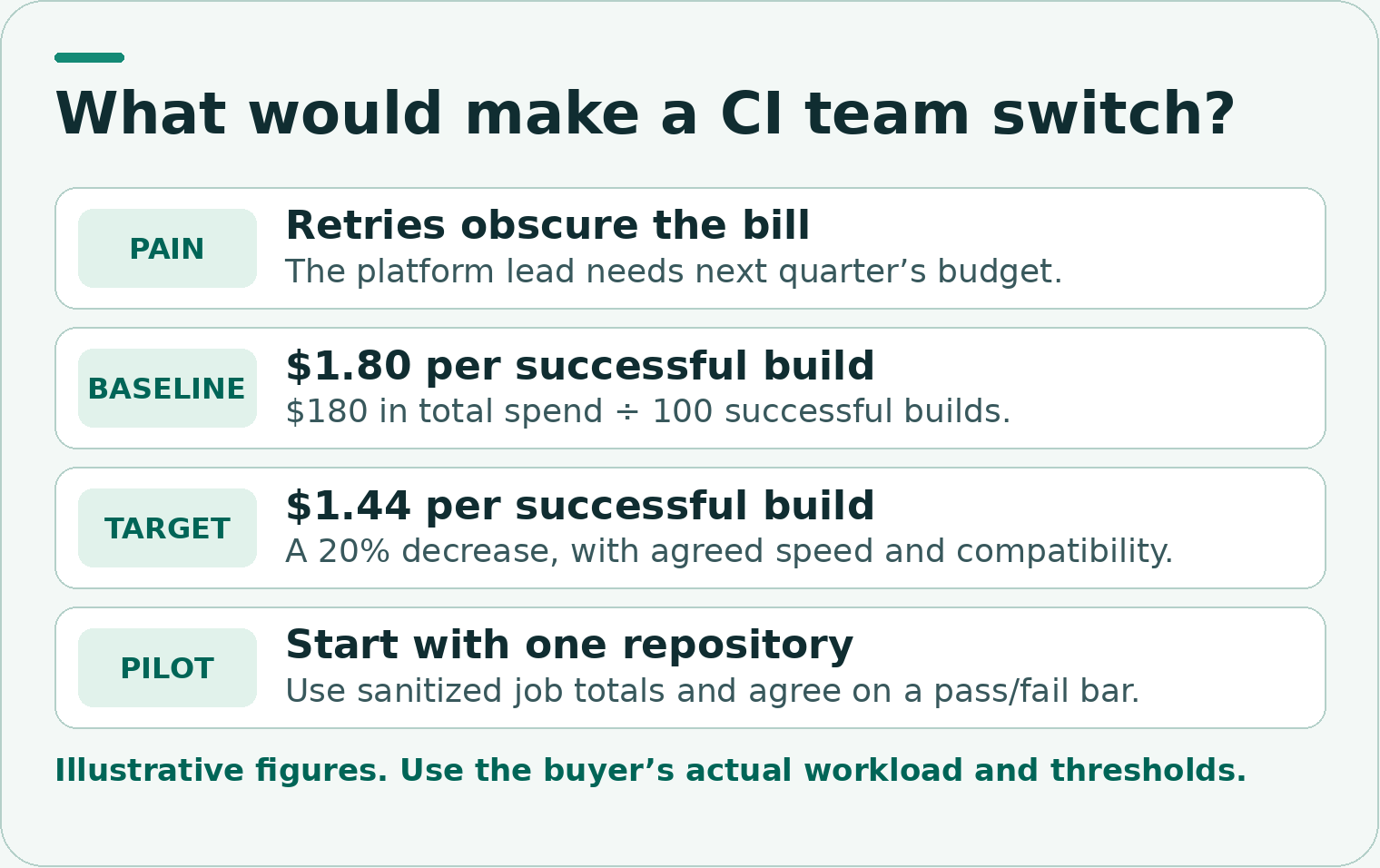
Founder’s offer: “Bring one week of sanitized job totals. We’ll calculate your cost per successful build and decide whether one repo is worth testing.” If tuning the incumbent clears the same bar, share the fix and look for a workload where your advantage holds.
Include the person who owns the CI bill and the engineer who owns the pipeline. One can judge whether the result matters to the budget. The other can tell you whether it survives secrets, cache behavior, and branch protections.
4. Publish the proof and get it in front of the right accounts
Start with one diagnostic and one way to try it. A developer can use the public asset to investigate. A champion can use the result to justify an evaluation. Sales can use the same material when there’s a credible reason to bring it up.
| Buyer intent | Asset | Next action |
|---|---|---|
| “Why did our usage spike?” | A diagnostic guide with worked inputs and current plan assumptions | Run the calculator |
| “Which alternative fits our stack?” | A comparison organized by workload, trade-offs, and requirements | Check the evaluation matrix |
| “Can we move without breaking anything?” | A migration guide with prerequisites, limitations, and rollback | Pilot one repo or service |
| “How do I get this approved?” | A shareable summary of cost, effort, risk, and test results | Review with finance, security, or the platform lead |
Make the answers discoverable in search and AI
Give each page a question it can answer well. Datadog custom metrics billing calls for an explanation of how usage is counted. Datadog alternatives for OpenTelemetry calls for an evaluation of fit across tools. Migrate Datadog metrics to OpenTelemetry calls for prerequisites, steps, and a rollback path. Link related pages so a reader can move from diagnosis to evaluation.
Lead with a direct answer, add a worked example, and put units, configurations, dates, limitations, and sources next to the claims they qualify. Make the core material available in indexable HTML. Use original data where you have it and document how it was produced. Give somebody ownership of updating pricing, feature, and migration claims. Google’s generative search guidance emphasizes standard SEO fundamentals and original, useful content. Google Search Central’s guide to generative AI search
Use Google Search Console for generative AI impressions, Bing Webmaster Tools for AI citations across supported surfaces, and analytics for observable referral visits and downstream conversions. For a small manual audit, repeat a fixed set of buyer prompts and log the engine, date, cited page, and whether the answer represented your claim accurately. Track visibility and business results as separate metrics. Google generative AI reporting · Bing AI Performance · OpenAI publisher FAQ
Reach out to the person who described the gap
A one- or two-star review can surface a workflow the reviewer would consider replacing. A four- or five-star review can surface an even more specific opening: the reviewer likes the product overall and names one job it handles poorly. The first case may warrant an offer to evaluate a replacement. The second often calls for a smaller offer, such as a way to fill the gap on one repo, alongside the tool they already like.
Prioritize recent reviews that describe a specific, material problem your product can address today. Check whether the incumbent has since fixed it. If the reviewer invites relevant recommendations or you have another appropriate basis to contact them through a permitted channel, lead with the answer to their problem. A public review alone does not grant permission to harvest contact details or send marketing. Respect the platform’s rules and the recipient’s preferences, and keep anonymous reviewers anonymous.
Low-rating example. Someone reports that their team spends hours reconciling failed builds and retries with its CI bill. Offer a worksheet that calculates cost per successful build from sanitized totals. Start with one workflow and ask whether the problem is still current.
Positive-review example. Someone likes their CI setup but says it takes too long to diagnose which jobs lost cache coverage. If your tool can show that at the job level, offer a short example they can try on one repository. The reviewer can evaluate the missing capability while keeping the workflows they already like.
Hi [Name], you mentioned that it’s hard to tell which CI jobs lose cache coverage. If that’s still a problem, here’s a sample repo that shows cache hits and misses by job. You can try it on one workflow alongside your current CI setup. Happy to share the config if it fits.
That example assumes a context where the reviewer has invited recommendations or otherwise welcomed the conversation. For broader outreach, carry forward the workflow and the offer. Use independently verified account context to decide who else should see it.
Use account-level signals to reach other buyers
Look for a first-party migration question, self-identified trial, public rollout, or permitted competitive intent signal. G2 Buyer Intent documents organization-level activity such as views of alternatives and certain competitive pages. Use those signals within your agreement and verify account fit independently. A view gives you evidence of account activity. Deployment, renewal timing, purchase plans, and who researched the product require separate evidence. G2 Buyer Intent data reference
For each target account, log the permitted signal and date, why the workflow fits, which asset matches, who owns outreach, and whether contact is suppressed. Apply your normal contact permissions and opt-out process. Route existing customers and active opportunities to their owners.
Example email after a public Kubernetes rollout announcement
Subject — Forecasting telemetry costs for the Kubernetes rollout
Hi [Name], I saw your team’s post about expanding Kubernetes across [publicly named services]. If you’re setting the telemetry budget for that rollout, we built a worksheet to estimate how tag growth affects custom metrics volume.
Here’s the worksheet. If you’d like help, we can run the model for one service using sanitized inputs and show which incident queries each configuration preserves.
The useful next event is a completed workload test, a qualified evaluation, or a request for a pilot. Count opens and clicks as diagnostics for the campaign itself.
5. Measure whether the motion creates incremental pipeline
Randomize eligible accounts, ideally within groups of similar intent, size, and prior engagement. Offer the treatment group the pain-specific campaign. Use standard outreach in the comparison group to test the new offer, or hold out outreach to estimate the effect of sending the campaign. Keep qualification rules and observation windows consistent. Public assets can reach both groups, so this test estimates the added effect of targeted activation under those conditions.
| Metric | Calculation |
|---|---|
| Qualified meeting rate | Accounts with a held meeting that meets your predefined criteria ÷ accounts assigned |
| Qualified opportunity rate | Accounts with a new stage-qualified opportunity in the window ÷ accounts assigned |
| Pilot activation rate | Eligible trials completing the technical test ÷ eligible trials started |
| Estimated incremental opportunities | Treatment accounts × (treatment opportunity rate − control opportunity rate) |
| Cost per incremental opportunity | Incremental campaign cost ÷ estimated incremental opportunities, when positive |
For example, if 8 of 100 treatment accounts create an opportunity and 4 of 100 control accounts do, the difference is 4 percentage points, or 4 estimated incremental opportunities per 100 treatment accounts. At $4,000 in incremental costs, the point estimate is $1,000 per incremental opportunity. With only 12 events, a simple approximate 95% interval runs from −2.6 to +10.6 percentage points. These hypothetical results would give you a reason to run a larger test sized for your baseline and minimum worthwhile lift.
Check downstream stage progression, wins, engineering time, and negative replies. Count each opportunity once and keep sourced and influenced pipeline distinct. If buyers use the worksheet and skip the pilot, inspect setup effort. If they complete the pilot and stay put, ask them what would have to change for the switch to be worth it.
Decide whether the economics justify scaling
For a founder, the cost of this motion includes engineering and sales time as well as spend on data, content, and distribution. Before buying tooling or automating the campaign, put a ceiling on what you can spend per qualified opportunity.
A simple estimate is allowable acquisition cost per customer × qualified-opportunity win rate. If you can spend $5,000 to acquire a customer and historically win 20% of comparable qualified opportunities, that gives you a $1,000 total acquisition-cost budget per opportunity. If downstream evaluation and closing already consume $300 per qualified opportunity on average, that leaves about $700 for generating each incremental opportunity. These figures are illustrative. Use your own gross margin, payback target, time costs, and comparable win rate.
Scale when the technical win repeats and the economics clear your bar. If buyers agree on the pain and decline a pilot, revisit urgency or switching cost. If pilots start and fail, fix the product or narrow the workload. If pilots pass and deals stall, find out who can approve the change and what evidence they need.
Run your first campaign in 30 days
| When | What ships |
|---|---|
| Days 1–5 | Product marketing chooses one segment, two or three alternatives, and approved sources. |
| Days 6–10 | Product marketing and sales tag observations, interview target buyers, and pick one workflow with a reason to act. |
| Days 11–17 | Solutions engineering verifies the mechanism and builds one reproducible diagnostic or test. |
| Days 18–23 | Growth publishes the asset and evaluation page, adds internal links, and instruments the first useful action. |
| Days 24–30 | RevOps and sales assign accounts, launch outreach, and start logging diagnostic use and qualified evaluations. |
Set the pipeline readout for a window that fits your sales cycle, such as 60 or 90 days after account assignment. You’re ready to replicate the motion when independent evidence confirms the pain, buyers can reproduce the advantage, and the incremental opportunity rate justifies the cost. Start with one workflow you can prove you handle better.
Frequently asked questions
How do you find negative competitor reviews on G2?
Within your permitted access, find the competitor’s product listing and look at recent low ratings and detailed dislikes in mixed reviews. Use filters where available to match your segment. Confirm the reported behavior against current documentation and, where practical, a representative test. G2 Terms of Use
Can you scrape G2 reviews or use AI to analyze them?
G2 requires prior written consent for covered automated extraction and restricts commercial exploitation and specified AI uses of site content. Confirm your agreement covers the use you have in mind. AI can help classify approved, de-identified research, with human verification before publication. G2 Terms of Use
Can you reach out to someone who left a competitor review?
Where platform rules and applicable outreach requirements permit contact, a specific, unresolved complaint can justify a relevant offer. Offer a useful diagnostic, workaround, or small pilot. Reviews with high ratings can be equally useful when the reviewer names a missing capability you can demonstrate.
Does a negative software review mean an account is ready to switch?
A review describes a user’s experience at a point in time. Look for separate evidence of timing, such as an inbound migration request, a public consolidation project, or licensed account-level intent. Ask what would make a switch feasible under the buyer’s current constraints. G2 Buyer Intent documentation
What should a devtool marketer build first?
Build the smallest artifact that answers the buyer’s hardest question. Start with a calculator for unpredictable spend, a reproducible workload test for performance, or a one-service pilot with rollback for migration risk. Give the buyer a way to try it with representative inputs before asking for a meeting.